
This is the story of a young Japanese pioneer who, in the early Meiji era, crossed the Pacific at the age of just twenty.
Alone in a foreign land, he carved out new trade routes for exporting Japanese raw silk to the United States. Facing cultural barriers, language difficulties, and a fiercely competitive market, he built a foundation for Japanese–American commerce through sheer determination and resilience.
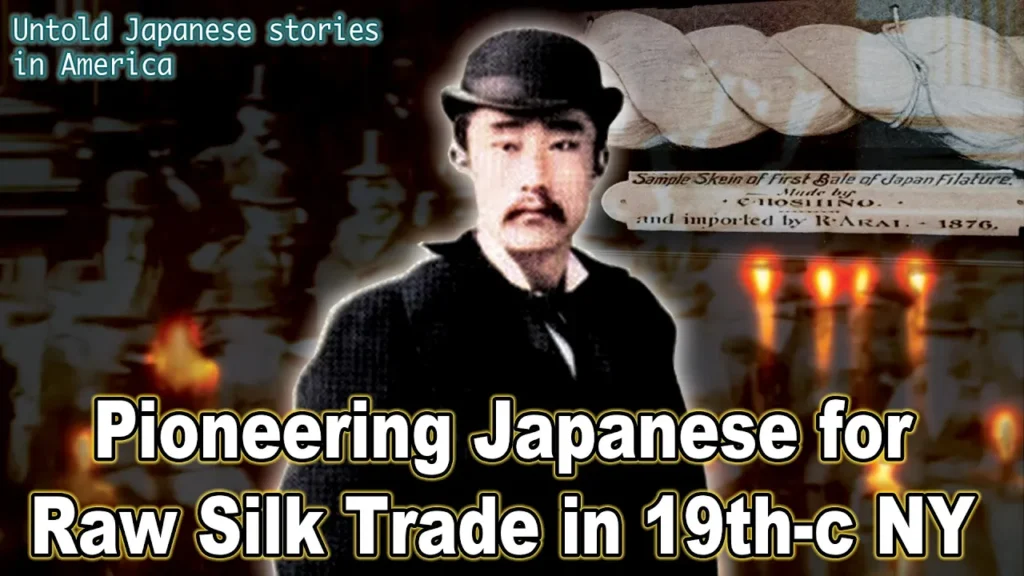
Silk, which has been a symbol of wealth since ancient times and called “God-given material”
Silk is a fiber made from the threads that silkworms produce when they make cocoons.
It is said to have originated in ancient China, and its manufacturing method has long been kept secret.
Legend has it that a princess hid silkworm eggs in her hair and took them abroad.
Beautiful silk products are popular in West Asia and Europe,
The east-west trade route was called the “Silk Road,” and silk products were traded for gold and jewels.
Since then, elegant and delicate silk products have continued to fascinate people in all ages and places.
Time passed, the 19th centur
It was an era when the industrial revolution took place in England and the mechanism of the capitalist economy was completed mainly in developed countries.
Japan, where a new government was established after the Meiji Restoration,
Under the name of “Fukoku Kyohei”, new Japan was looking for a way to earn foreign currency by exporting Japanese products to foreign countries.
The Meiji government turned its attention to raw silk as a material for silk products.
The production of raw silk, which was already thriving in various parts of Japan, was called “Shokusan Kogyo”.
The government supported its development.
To sell Japanese raw silk to the world, which can be said to be a “national policy”,
There was a man who literally gave his life.
Rioichiro Arai, known as the “founder of the Japanese raw silk trade”.
At the age of 20, he went to the United States and worked hard to sell raw silk.
He helped Japan grow into the world’s number one raw silk exporter.
There were the giants of the silk industry.
Sometimes he didn’t go as planned and he was anguished.
The most important thing that supported him was “honesty”.
We’ll tell you how a man who was at the mercy of the times and who was loved by the times came to be called “the founder of the Japanese raw silk trade”. We approach his turbulent life.
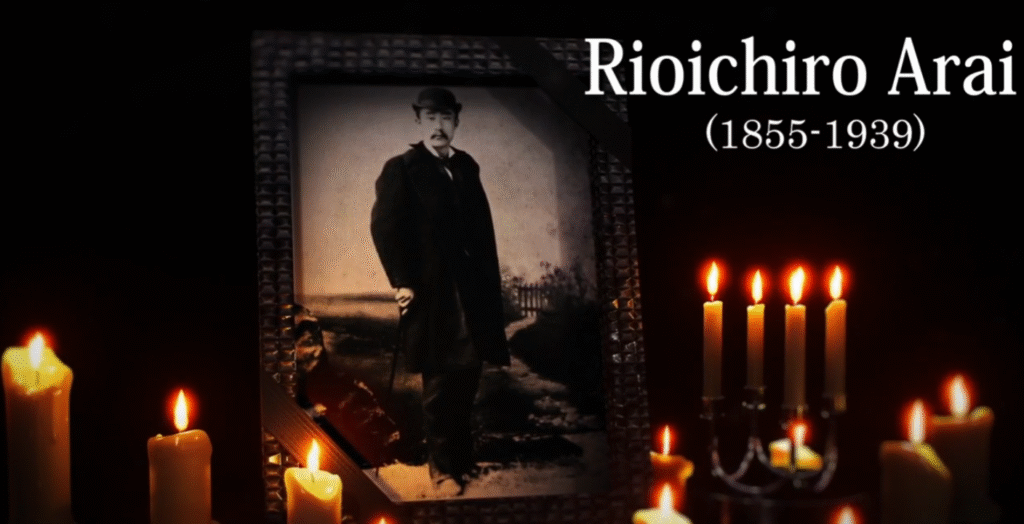
Rioichiro Arai was born in 1855 in what is now Kiryu City, Gunma Prefecture.
Born in Mizunuma Village, Kozukenokuni.
His birth family, the Hoshino, was a leading farmer in the region and was allowed to use the surname and sword.
The family had been engaged in sericulture for generations.
At the age of 12, he was adopted by the Arai family, a raw silk wholesaler.
He took the name Rioichiro Arai.
Before long, Rioichiro went to Tokyo and attended Kaisei School, the predecessor of the University of Tokyo.
The Meiji period had just begun. He studied English and business.
Gunma Prefecture had a thriving sericulture industry, as did Mizunuma Village, Arai’s hometown. That cold climate is suitable for growing mulberry trees for silkworms.
It was said that during the Heian period, silk products made in this area were presented to the Imperial Court.
The Meiji government, which promoted the production of raw silk as a new industry, established the Tomioka Silk Mill, Japan’s first government-run raw silk production factory, in this area.
At that time, the silk industry was facing a major turning point worldwide.
The decline of French products that had long led the industry was conspicuous,
Instead, it was America that was mass-producing silk.
After the Civil War, a large number of immigrants from all over the world flowed in.
Many industries were industrializing and the economy was booming.
At the World’s Fair in Philadelphia, which was celebrating 100 years of American independence in 1876, the new Meiji government poured a huge budget into promoting Japanese products, including raw silk.
Its high quality was introduced in local newspapers as the “the yankee nation of the east.”
Japanese products had been attracting attention in the ever-growing American market.
Well, Arai had a real brother who was 10 years older than him.
His name was Chotaro Hoshino.
Chotaro, a wealthy farmer in Gunma, also saw the potential of the raw silk trade.
He established the Mizunuma Silk Mill, a raw silk factory, in his hometown of Mizunuma Village. He embarked on the export of raw silk.
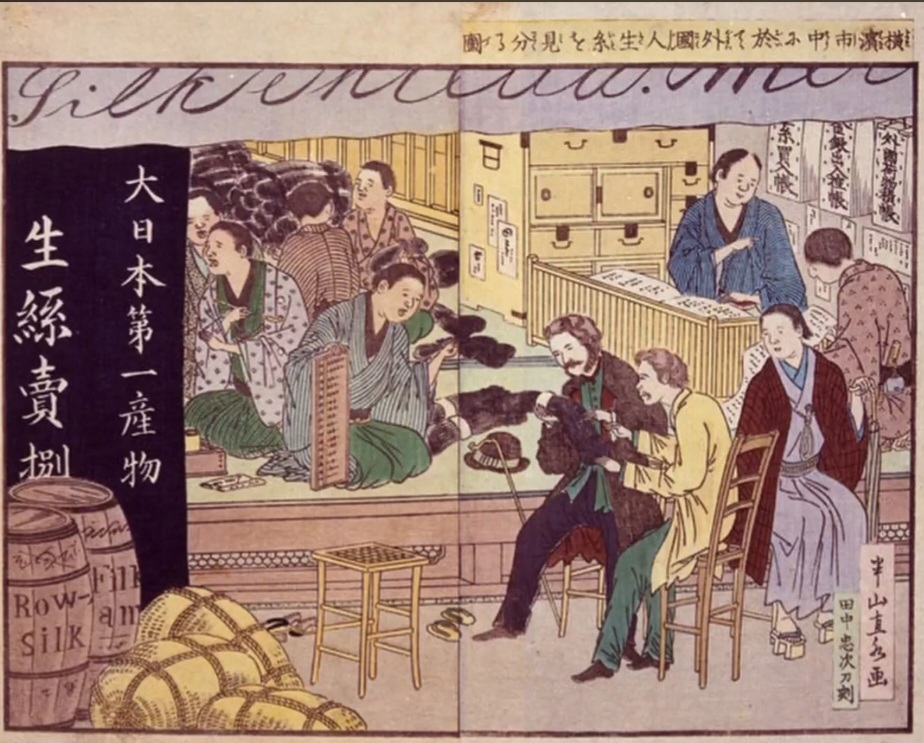
However, there was a big hurdle to the export of raw silk at that time.
When exporting not only raw silk but also Japanese products overseas,
It was common to pass through the foreign settlement in Yokohama,
There was a system in which the foreign merchants who acted as the window got a big profit.
Chotaro did not go through the hands of foreign merchants like this,
Selling directly to overseas raw silk traders,
He began to explore the so-called “direct trade ” route,
He planned to send Rioichiro Arai, his younger brother, abroad.
Rioichiro has been involved in sericulture since he was a child.
In addition, Arai, who is learning English, was just the right person.
Around that time, Momotaro Sato, who had been living in the United States a little earlier,
He was looking for a partner to start a business in New York.
Chotaro entrusted his younger brother Ryoichiro to Sato,
Arai and his party decided to go to America on the Oceanic, a passenger liner.
At that time, the young people who traveled to America with Arai and Sato on the Oceanic, were later called the “Oceanic Group”.
It would be handed down for a long time as a pioneer of Japan-US trade.
The year was 1876, and Arai was only 20 years old.
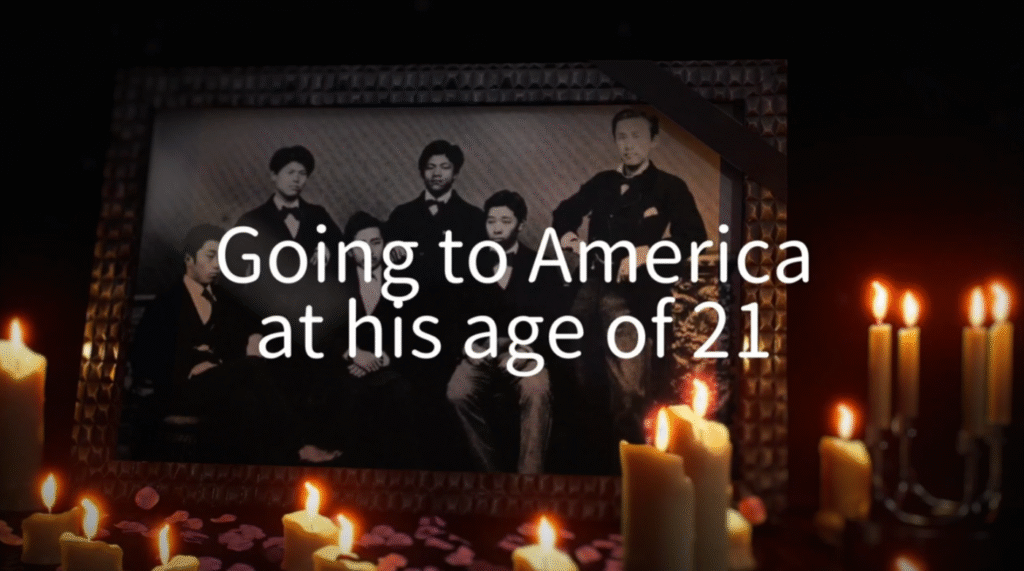
At that time, the American silk industry was in full swing.
At the center of this was the American Silk Association, formed by influential people in the industry.
Publishing a regular bulletin, from importing raw silk to manufacturing and selling silk products
It covered everything related to silk.
The U.S. government also encouraged the domestic production of silk products.
A high tariff of 60% was imposed on silk products imported from overseas.
For this reason, the import volume of raw silk from all over the world to the United States continued to increase,
It had nearly tripled in the last ten years.
Arriving in New York, Arai immediately tried to visit an influential raw silk broker, holding raw silk from Mizunuma and a letter of introduction from the New York consul,
It was the time when Japanese raw silk began to attract attention.
Arai’s heart must have been full of hope.
However, Arai’s first transaction ended in failure.
The broker, William Skinner, met Arai and brought out a bundle of raw silk.
He said it was Japanese raw silk that he had purchased before.
Surprisingly, the raw silk was mixed with metal pieces.
The Japanese merchant was cheating to disguise the weight and sell the raw silk at a high price.
To increase trust in raw silk made in Japan and Japanese people,
At this time, Arai must have learned what it takes to do business in a foreign country.
Four weeks later, Arai visited another broker, Briton Richardson.
Knowing the high quality of Japanese raw silk, he liked Arai.
Business talks went smoothly as if the previous negotiations didn’t exist, and the transaction was completed at 6.5 dollars per pound.
Arai was successful in selling 400 pounds, approximately 1.8 kilograms.
But then things took an unexpected turn.
After Arai sent Chotaro a letter telling the details of the contract, including the price,
The price of raw silk in Japan had risen by about 80%.
This summer, raw silk production in Europe plummeted, and the price of Japanese raw silk skyrocketed.
Selling at the price Arai signed the contract would result in a loss of approximately $1,500.
It was a tremendous loss for Chotaro, whose business had yet to get off the ground.
This would go bankrupt.
Chotaro suggested to Arai to negotiate the amount with Richardson again.
But Arai had a different idea.
When Arai’s last deal failed, he learned strongly that what should be won is not “money” but “trust”, first of all.
“Overturning the contract which was signed will lead to trust problems”
He stubbornly refused Chotaro’s proposal.
Chotaro respected Arai’s determination and managed to raise money by selling off household goods and other items.
Richardson, who was a close observer of market trends, would naturally have expected Arai to negotiate the price again.
But Arai didn’t do that.
Richardson thanked Arai for his sincerity and sent the following letter:
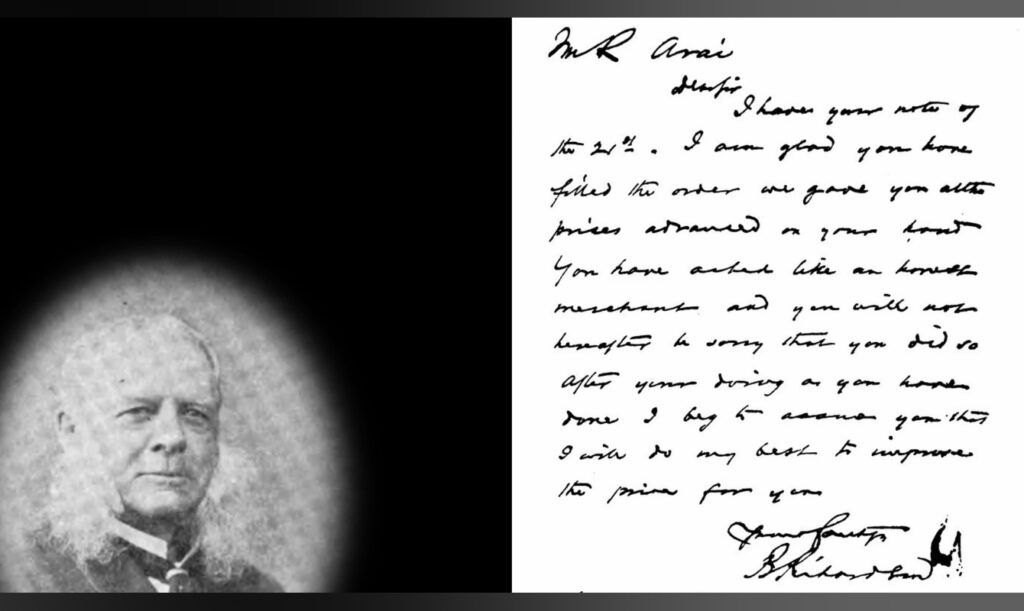
Dear Mr. Arai
I am glad you have filled the order we gave you although prices advanced on your hand. You have acted like an honest merchant and you will not hereafter be sorry that you did so. After your doing as you have done I beg to assure you that I will do my best to improve the price for you.
Your faithfully,
Britton Richardson
Richardson paid tribute to this young Japanese businessman,
He ended up adding $1 to the price per pound and trading at $7.50.
In this way, for the first time, Japanese raw silk was exported from Japan without any hands of foreign merchants.
Behind this historic deal success, there was Arai’s conviction,
“The most important thing in business is to be honest with customers.”
There was another reason why his older brother Chotaro sent Arai to America.
Chotaro wanted Arai to deliver the latest information on the local raw silk industry.
As already mentioned, in Japan at that time, foreign merchants often acted as contact points for trade.
Also, they had a monopoly on information on overseas markets,
It meant Chotaro or other Japanese silk companies couldn’t reach out to the latest information such as what kind of products were hot in America.
About half a year after the first transaction was concluded, Arai wrote to Chotaro,
“Japanese raw silk is not suitable for filament winding processes and is unpopular with American traders.”
He accurately pointed out the weaknesses of Japanese raw silk.
It was information that could only be known by Arai, who was able to hear the voices of people involved in the field.
In the United States, where the industrialization of silk products had begun, what producers were looking for was raw silk of uniform quality.
Because raw silk is made from the thread exhaled by silkworms,
In the first place, there is likely to be unevenness in quality.
In addition to that, it became even more difficult to maintain uniform quality because the raw silk was made using a unique Japanese manufacturing method in which wooden tools are moved by hand to create bundles.
Being advised by Arai, Chotaro developed a raw silk that uses the more power of machines instead of manual production.
The raw silk produced by this manufacturing method had less unevenness in quality than conventional ones,
It was quickly accepted by the American market.
Chotaro got a feel for it, solicited investors and established Doshin Kaisha, a raw silk export company, in Yokohama.
Rioichiro was appointed as New York branch manager.
His older brother and younger brother, Japan and America are far apart, but together,
They finally got a foothold to start a business in New York.
In the 1880s, the silk industry flourished in America.
In Paterson, known as “Silk City”, just 20 kilometers from New York City,
Massive capital investment gathered and rapid mechanization to manufacture silk products grew.
Around this time, a high-speed railroad dedicated to transporting raw silk to New York, the so-called “silk train,” was born.
The infrastructure to transport Japanese raw silk arriving in San Francisco and Seattle to the East Coast was in place.
The amount of exports from Japan continued to increase and
Japanese raw silk became an indispensable presence in the American market.
However, exports of raw silk, which seemed to be smooth sailing, gradually began to show signs of fraying.
Japanese producers could not keep up with the rapidly increasing demand for raw silk.
As a result, it became impossible to maintain the quality of raw silk that American traders were satisfied with.
The Silk Association of American criticized in its annual report
“It is an occasion for profound regret that the excellence reputation which had been fairly won in this market for the silks of Japan, should be so carelessly imperiled.”
In order to overturn this notoriety, Arai traveled back and forth between Japan and the United States to explain to Japanese silk mills the standards that the American side needed.
This is a record of a speech that Arai gave in Japan at that time.
There was a passage on it like this. “Do not disobey the wishes of consumers.”
Producing only what the customer needs and winning trust.
Moreover, making more effort is needed to gain trust in America, where the culture and lifestyle are completely different.
Arai made such a speech in front of the crowd.
In the first place, the fundamental reason why inferior products flow into the market is that Japanese raw silk producers were once chronically short of funds.
Although Japanese raw silk trader managed to make a direct trade,
Most of the Japanese silk exports were still held by foreign merchants.
It could not be said that the income of Japanese raw silk producers was very high.
In addition, the government announced a policy to reduce subsidies due to repeated recessions.
Mizunuma Silk Mill, run by his older brother Chotaro, also struggled with cash flow.
It was soon out of business.
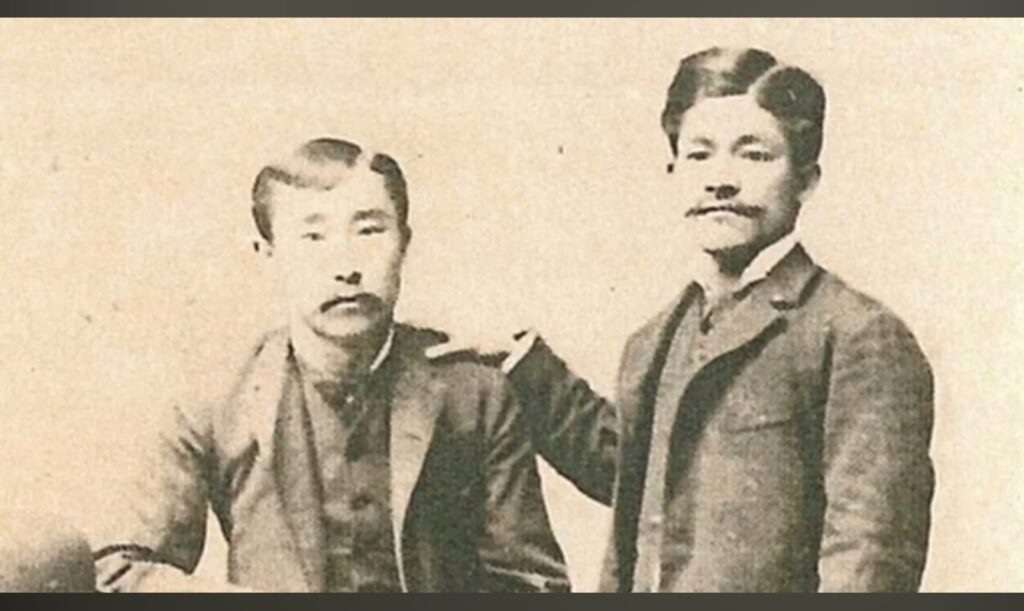
Also, under New York City law, it is better to establish a local corporation.
In many cases, preferential treatment is given in terms of taxes and bills,
Arai, who was always struggling with cash flow, strongly appealed for the company to become a local subsidiary.
However, Chotaro refused to invest in the establishment of the new company,
Little by little, a rift began to form between the brothers.
During this period, there were other Japanese raw silk exporters in America besides Arai, however,
Arai was the only person known to the New York business community.
Richardson, who signed a contract with Arai to sell raw silk for the first time,
was the secretary of the Silk Association of American at this time and mentioned of Arai’s business attitude with a high evaluation,
“Rioichiro Arai of the Doshin Kaisha company is trying to improve the quality of inferior products.”
While working on business as a bridge between Japan and the United States,
With few people around him who understood him, Arai continued to fight alone.
How was the sky of New York reflected in his eyes?
To Arai, who was working on his business with sincerity,
A friend reaches out for help.
About 20 years ago, a guy who went to America on a ship with Arai.
Toyo Morimura, one of the “Oceanic Group”.
Morimura, who was successful in the direct trade of ceramics in New York,
suggested to Arai that he should quit Doshin Kaisha and do business together.
Starting a business with Morimura,
In other words, it meant parting ways with his real older brother, Chotaro.
Nevertheless, for the sake of Japan’s national interests, and in order to improve the reputation of Japanese people in the United States,
Arai, who wants to devote more effort to the raw silk trade,
established a New York-based local corporation called “Morimura Arai Company” in 1893.
Ironically, by parting with his brother, who gave him the opportunity to do business in America, Arai’s business was getting more and more on track.
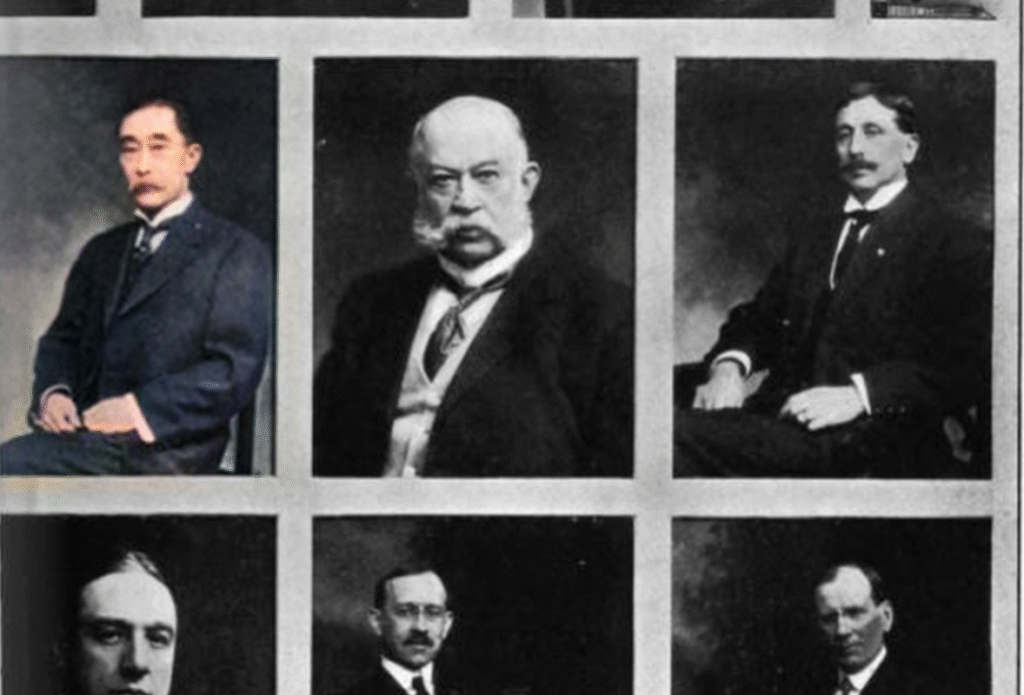
In 1901, Arai’s long and lonely battle bore fruit.
Recognized for supporting the growth of the silk industry as a bridge between Japan and the United States,
He was the first Asian to be elected to the board of directors of the Silk Association of America.
Arai’s company was getting more and more successful,
It accounted for about one-third of the raw silk exports from Japan to the United States.
This was the top number even including foreign merchants.
Since then, direct trade by Japanese merchants had been widely accepted in the United States.
In addition, Arai’s activity extended to socializing.
An annual dinner attended by 800 people, hosted by the Silk Association of America,
By becoming a board member, Arai’s presence increased,
Top diplomats, such as the US minister at the time and the New York consul general, were invited.
In 1905 he was an influential figure in the Japanese community of New York.
Together with Jokichi Takamine and Yasukata Murai, he contributed to the founding of the Nippon Club.
Such social activities increased Americans’ understanding of Japan,
Japanese silk became more and more accepted in the American market.
By 1920, raw silk accounted for one-third of total US exports from Japan.
The “bond of trust” started from just 400 pounds,
And it grew into a huge business exceeding 200 million yen.
At this time, Arai was 65 years old and had spent two-thirds of his life in the United States.
Japan, which was said to be a second-class country when Arai first went to America,
Was recognized as a first class country in the world.
Arai’s success story was exactly the same as the time when Japan spread its wings to the world.
A man who was loved by the times and grew with the times, came to be called “the founder of the Japanese raw silk trade” before he knew it.
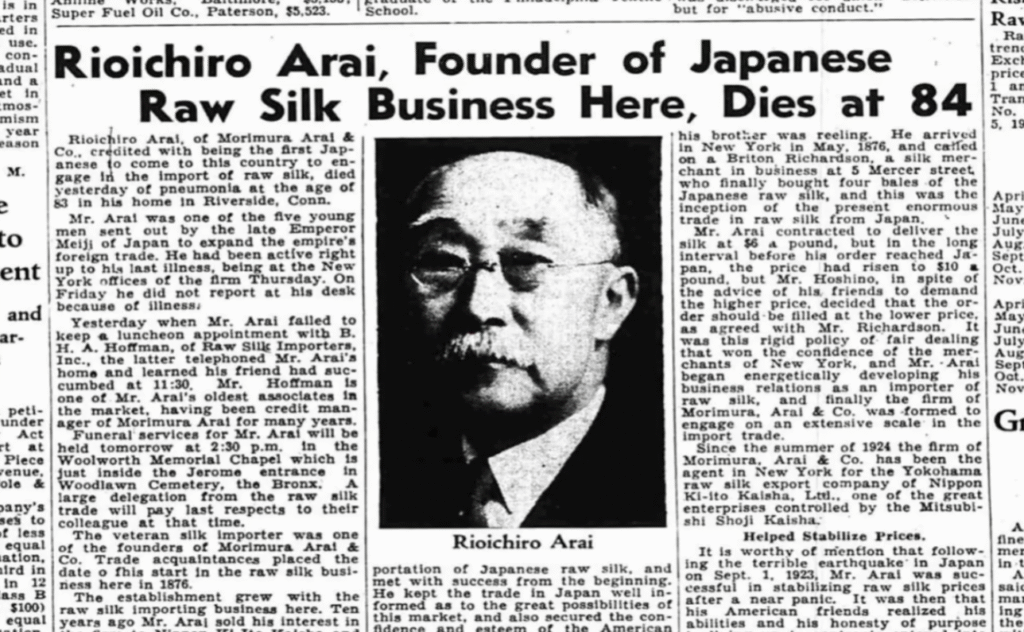
The story ended in 1939.
Arai, who was living comfortably in his home, died of pneumonia. He was 84 years old.
In mourning a loss of a legend of the silk trade,
The American Commodity Exchange paid him the unusual tribute of one-minute silence while the funeral was in progress.
Arai devoted his life to being honest and winning trust .
They will be alive, forever.