
In the early Meiji period, traveling from Japan to the United States was a far greater decision than it is today.
For a young man heading to a global metropolis like New York, the journey was nothing short of a life-risking adventure.
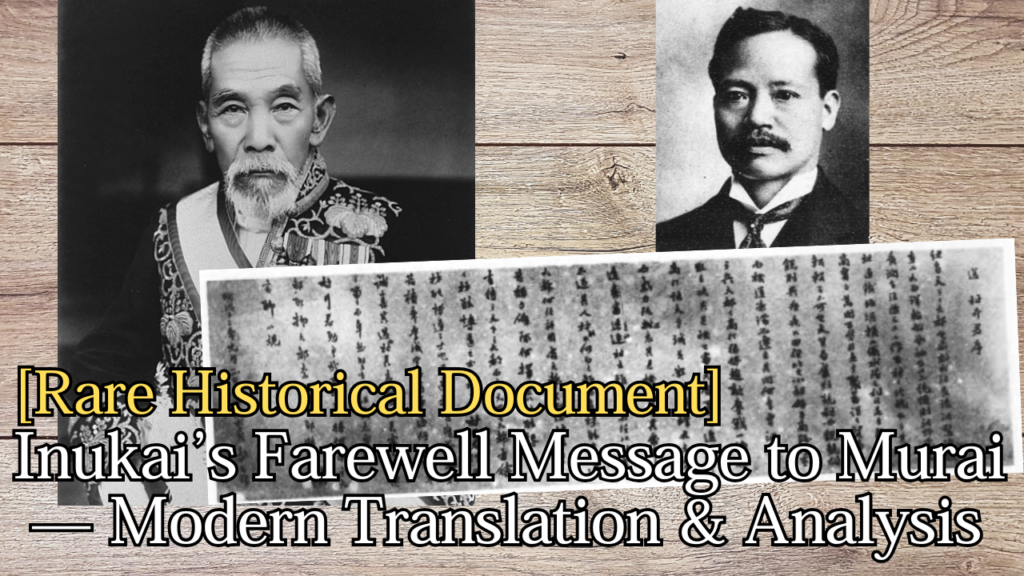
In Meiji 12 (1879), as Yasukata Murai prepared to depart for America, his fellow student from Keio Gijuku—who would later become Prime Minister—Tsuyoshi Inukai presented him with a farewell message written in classical Chinese.
This text goes far beyond a simple note of encouragement between friends.
It is imbued with expectations for a man destined to shoulder the future of a modern nation.
In this article, we present the full original text, a modern translation, and a detailed analysis of its meaning.
■Original Text『紐育村井君序』“Preface for Murai of New York”

紐育村井君序
維有天下之大河也
前則大河之長波叢叢
所以養天下之平原
水後之利於是乎在矣
四方之商賈萬国之貧負
總競利共困於貧富之常理
必能利衆則免於累
何常理之不可恃也
比之大都之興然
以財氣能大其所施用
有大都矣 何人材能奈之
不過大都何所施用
有大都矣 不過人材能奈之
天下之大都有待於天下之大都
而天下之大都以材能博達之士也
嗟友村井
君能博逹之士也
余誠保君能博逹之士也
今茲商事遠行維昔
小都之商猶往往於城危疑難避
義塾積年學成
今茲商事遠行維昔
又未之而氣力徒洒涙
其見機也速
其聞相去避其面所致之者
不甚其人材能如何自已
雖然多々資額與解釋如何攸
是以村井君勉乎
勿然落志
将何求干大都耶
抑大都奈君何耶
臨別造此言聊以规
明治十二年九月二日
扈交犬養毅再拝
■ Preface for Mr. Murai Departing for New York
The great rivers of the world begin as small streams on the plain.
As they flow onward, they swell into great waves and come to nourish vast lands.
It is there that the true benefit of a great river lies.
Merchants across the world—rich and poor alike—
compete relentlessly in pursuit of profit.
Yet if one can create benefit shared by many,
one may escape the suffering born of inequality.
The rise of great cities follows the same principle.
Capital and human talent gather there,
enabling enterprises of immense scale.
Yet even if a great city exists, it is meaningless without capable people to make use of it.
And there are many endeavors that can only be accomplished in such cities.
The great cities of the world await individuals worthy of them—
those endowed with broad knowledge and discernment.
Ah, my friend Murai.
You are precisely such a person.
I sincerely believe that you will demonstrate this breadth of ability.
Even commerce in small towns has long involved danger and difficulty.
Now, having completed many years of study,
you set forth on a distant commercial journey.
There is no need to shed tears before even setting foot on the path.
Opportunities often arrive sooner than expected.
Do not allow immediate circumstances to cause you to doubt your own strength.
No matter how great the financial burdens or hardships,
there will always be a path forward.
Therefore, Murai, do not let your resolve falter.
If you do not challenge the great city, what then will you seek?
Indeed, it is the great city that needs you.
At our parting, I offer these words as humble counsel.
September 2, Meiji 12 (1879)
Tsuyoshi Inukai
■Commentary: Tsuyoshi Inukai and Yasukata Murai: Youthful Friendship and High Expectations
Even this single farewell text reveals much about the relationship between Inukai and Murai.
① Fellow Students at Keio Gijuku
The phrase “after many years of study at the academy” indicates that the two men studied together in Tokyo.
At the time, Inukai was still in his twenties.
Murai, slightly younger, was already regarded as a man of great promise.
② Inukai’s High Appraisal of Murai as a “Man of Broad Vision”
The repeated phrase “a person of broad learning and discernment” is telling.
Inukai did not see Murai merely as a friend, but as a merchant who would shape Japan’s future.
Murai would later play a major role at Morimura Brothers and become a central figure in the Japanese community in New York—making Inukai’s words almost prophetic.
③ A Glimpse of Inukai’s Vision of the Modern State
Statements such as
“Great cities await capable individuals” and
“The essence of commerce lies in benefiting many”
echo Enlightenment thought and modern theories of management.
This farewell is simultaneously a personal encouragement and a meditation on national destiny—revealing Inukai’s emerging political philosophy.
④ New York as a Life-Defining Gamble
In 1879, traveling to New York involved serious danger, scarce information, and great financial risk.
By invoking the metaphor of a river’s source, Inukai frames Murai’s journey as a small stream destined to become a great river.
■ Conclusion
This farewell message is a remarkably valuable historical document, capturing the moment when young Meiji-era intellectuals set their sights on the wider world.
Carrying these words with him, Yasukata Murai crossed the Pacific and went on to contribute significantly to the growth of Morimura Brothers and the Japanese presence in New York.
Here we glimpse the origin of Tsuyoshi Inukai’s lifelong belief in human potential and ambition that transcends national borders.