

During the Meiji era, how did young men from Japan live after crossing the ocean to America, an unfamiliar foreign land?
Information was scarce compared to today, the language was a barrier, and at times they were even mocked and mistaken for Chinese.
Yet despite these harsh conditions, they endured—and lived on with remarkable resilience.
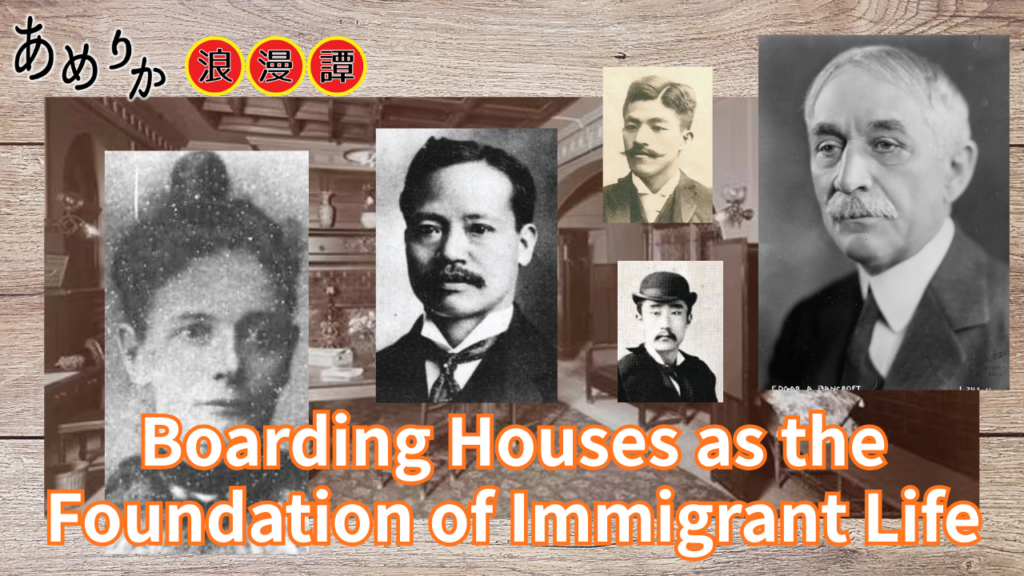
Boarding Houses as the Foundation of Immigrant Life
In the 1870s, as Japanese began arriving in New York in earnest, the primary form of housing for young single men and newly arrived immigrants was the boarding house.
Unlike modern apartments, boarding houses typically offered both lodging and meals (“board & room”) as a single package, making them an especially practical option for those just beginning life in a foreign land.
At the time, Manhattan still lacked sufficient housing designed for single occupants. As a result, many people who came to the city in search of work first took up residence in boarding houses, which functioned as both homes and social hubs.
A Communal Way of Life
Residents usually rented modest private rooms and shared meals in a common dining room.
In many cases, breakfast and dinner were included in the rent, creating a truly communal living environment.
Meals were simple, home-style fare. With little need to worry about cooking or household chores, boarding houses were extremely convenient for single men focused on work or study.
Rent was said to average around $20 for two weeks, a manageable expense even for young men of limited means.
Both Toyo Morimura and Rioichiro Arai moved from one New York boarding house to another during their early years.
In Arai’s letters, he even notes a period when he deliberately avoided living with other Japanese, remarking that “one cannot improve one’s English when living only among fellow Japanese.”
「“The Dudley House”: A Boarding House Favored by Japanese Residents
By the 1880s, various sources confirm the existence of boarding houses that could be described as “Japanese-preferred” establishments.
One such place was run by Mrs. Dudley, a woman originally from New England. She was known for welcoming Japanese tenants, reportedly because she found them clean, quiet, and respectful.
“At that time, Toyo, Murai, and Arai were all lodging at Mrs. Dudley’s house on West Ninth Street.
She did not discriminate against Japanese, and even staff from the Japanese Consulate stayed there.”— The Unknown Life of Toyo Morimura, Pioneer of U.S.–Japan Trade
“Mrs. Dudley was a rare Japanophile in New York.
For that reason, selected Japanese—including Consul Shinkichi Takahashi, Saburo Fujii, Ryoichiro Arai, Toyo Morimura, and Murai—stayed there with peace of mind, almost as if it were a permanent home. American clerks and students also lodged there, and the house prospered.”— The Biography of Yasukata Murai
“Shinkichi Takahashi, the fourth Japanese consul, resided in a room at Mrs. Dudley’s house, 55 West Ninth Street, during Meiji 14–15.”
— A History of the Development of Japanese in New York
Not only early pioneers of U.S.–Japan trade such as Arai, Morimura, and Murai lived there—even the highest-ranking Japanese diplomat in New York at the time called the Dudley House home.
Tracing the Dudley House Through City Directories
Let us take a closer look at the Dudley House itself.
The New York Public Library (NYPL) has digitized City Directories for every year since 1789, all freely accessible online. These directories list residents and addresses year by year.

In the 1878–79 directory, we find the entry:
“Dudley Delia, h 55 W. 9th”
Here, “h” indicates “house,” meaning she resided at that address. This confirms that Mrs. Dudley was living at 55 West 9th Street as early as 1878.
In other years, the listing reads:
“Dudley Delia A., wid Joseph, h 55 W. 9th”
This tells us that she was the widow of Joseph Dudley.
At the time, it was quite common for widows to operate boarding houses as a means of livelihood.
The first confirmed instance of Arai living at 55 W. 9th Street appears in the 1879–80 directory.
Morimura, meanwhile, was initially listed only by his workplace address.
That same directory includes several other names that appear to be Japanese—Momotaro Sato, Makoto Fukui, and Osamu Yamada—suggesting that at least four Japanese residents were living at the Dudley House at that time.
In later years, both Morimura and Yasukata Murai are consistently registered at the Dudley House.
Morimura’s elder brother Ichitaro (later the sixth Morimura Ichizaemon) also appears in the directory, with his address simply listed as “Japan.”
A Refuge for Young Men with Big Dreams
Calling it “a boarding house where poor but passionate young men gathered to speak of their dreams” may sound romanticized—but there is little doubt that many young Japanese businessmen were sustained, emotionally and practically, by this place during their earliest years in America.
An Unexpected Connection to a Future U.S. Ambassador

An especially fascinating episode involves Edgar Bancroft, who later served as U.S. Ambassador to Japan beginning in 1924 (Taisho 13).
Bancroft was known as a strong pro-Japan figure and worked to improve U.S.–Japan relations at a time when tensions were worsening.
According to The Biography of Yasukata Murai, Bancroft recalled the following at a party held by the Japanese community in New York upon his appointment:
“When I was a student at Columbia University, I lodged at a boarding house on Ninth Street in New York together with several Japanese.
They were all fine gentlemen, and I remember holding them in deep respect.”
As a student, Bancroft had stayed at the very same Dudley House.
It is possible that his later sympathy toward Japan—and his efforts to improve bilateral relations—were shaped in part by those early experiences living alongside Japanese residents.
Murai and the “Poster Girl” Caroline: A Marriage Born at the Boarding House

Mrs. Dudley had a sister named Caroline. Intelligent and unpretentious, she captured Murai’s heart, and the two married in 1886.
It is said that Mrs. Dudley herself played a role in encouraging the match, remarking:
“That big-eyed man is bound to become someone important.”
Murai’s Words of Proposal
- If I succeed, I will not monopolize wealth, but use it for the public good.
- If I fail, I will endure life at rock bottom together with you.
For Caroline, a devout Christian, Murai’s emphasis on social contribution and self-sacrifice may have been especially compelling.
After marriage, she avoided ostentatious social life and earned a reputation for modesty and virtue—some accounts even describing her as more reserved than many Japanese wives of the time.
The Paths of the Three Men Thereafter
With business going well, Murai eventually purchased a grand residence in Riverside, then a prestigious residential district, and moved there with his wife.
Arai, who married around the same time, relocated to the same neighborhood.
Morimura, still effectively on a solo assignment, frequently stayed at Murai’s mansion as a guest.
The Fate of the Dudley House
Unfortunately, no definitive records reveal what ultimately became of the Dudley House.
After 1884, the name Delia Dudley disappears from the City Directory. She may have moved, remarried, or been listed under a different surname.
However, although Murai moved out after marriage, records confirm that Arai and Morimura continued living at the same address until 1888.
This suggests that even if Mrs. Dudley was no longer the owner, the house likely continued to function in some form as a “Japanese house.”
By the 1889–90 directory, both Arai and Morimura are listed at new addresses, confirming that they had left by that point.
Because the City Directory lacks robust search functionality, identifying all residents of the house remains difficult. It is quite possible that many more Japanese lived there than can now be confirmed.
Yet the sheer number of later testimonies referring to this place speaks volumes.
It was, without doubt, a crucial refuge for Japanese who struggled, learned, and persevered in a foreign land during the earliest days of their American journey.