
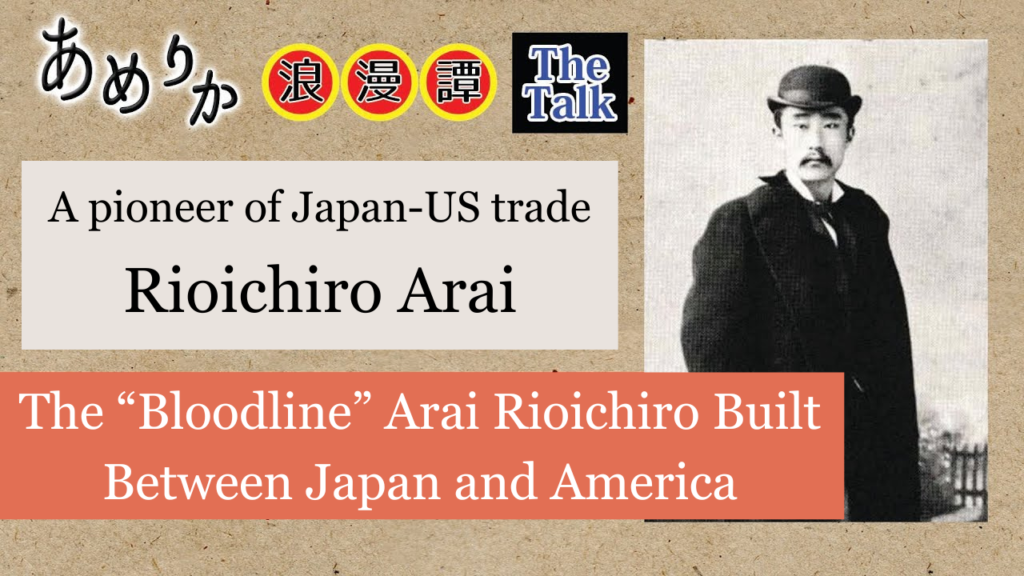
A Japanese Businessman Known in America: The Japan–U.S. Story Woven Together by Silk
Hello.
This time, I would like to dig a little deeper into some supplementary episodes about Arai Rioichiro that I couldn’t fully cover in the video I produced about him. My conversation partner is Yume.
A Figure Known in America but Unknown in Japan
Yume:
“He’s someone you never hear about on ordinary TV programs, so I found it extremely interesting.”
In fact, Arai Rioichiro is a very well-known figure in the United States.
When he passed away, an obituary appeared in The New York Times, and at the raw silk exchange a moment of silence was observed in his honor.
Despite such remarkable achievements, he is almost unknown in Japan.
Because I live in New York, I found it fascinating to begin researching and uncovering these kinds of “buried stories of Japanese individuals.”
A Book I Referenced: Samurai and Silk
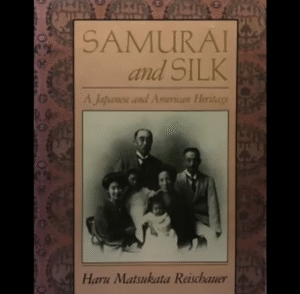
One of the main references for this video was the book Samurai and Silk.
It was originally published in Japanese under the title Kinu to Samurai (Silk and Samurai), written by Haru Reischauer—the wife of Edwin O. Reischauer, the former U.S. ambassador to Japan.
She is the granddaughter of Arai Rioichiro, and also the granddaughter of Masayoshi Matsukata, Japan’s third Prime Minister.
In other words, the story that connects “silk” and “samurai” is told through a family line that inherited the blood of both Japan and the United States.
From the Sixth Son of a Farming Family to an American Businessman
Arai Ryōichirō was born as the sixth son of a farming family.
His eldest brother, Hoshino Chōtarō, was a prominent local landowner who later succeeded in the raw silk trade and even became a member of the National Diet.
In contrast to his brother, Ryōichirō carved out his own path by pioneering and succeeding in the raw silk trade in the United States.
At the time, Japanese raw silk generated enormous transactions in the New York market and was one of the most important export commodities supporting Japan’s economy.
Ryōichirō supported this distribution system and even influenced movements toward legal and institutional frameworks—truly a pioneering figure.
Brotherly Conflict Behind the Success
However, his life was not smooth sailing.
There was a deep rift between him and his brother, and his brother passed away without the two ever reconciling.
Around 1935, however, his brother’s grandchild (the child of Rioichiro’s nephew) came to visit him, which finally led to reconciliation.
Not long after that, Rioichiro himself passed away in 1939.
Only in his later years were the emotional barriers lifted—a real-life story that feels almost like a drama.
The Family He Built in America and “The First Japanese Child”
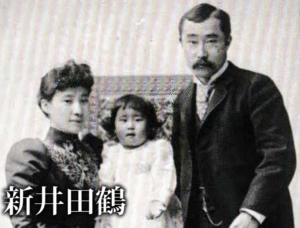
Rioichiro married Tazu, the daughter of Ushiba Takuzō, who is known as “the father of the Sanyō Railway.”
A child was born to them in New York, and this child is sometimes described as “the first child born to two Japanese parents on the U.S. East Coast.”
At the time, New York was populated almost entirely by Japanese businessmen, and there were very few Japanese women.
Rioichiro’s wife struggled in a foreign land where she neither spoke the language nor shared the culture, yet she gradually integrated into the community, teaching ikebana and other arts.
The Women Who Laid the Foundations of the Japanese American Community
After World War I, the Japanese community in New York expanded rapidly.
At the center of this growth were women like Ryōichirō’s wife.
She is said to have been one of the founding members of a Japanese women’s association, supporting grassroots Japan–U.S. exchange and laying the foundations of the Nikkei community.
In Closing
Seen in this light, Arai Ryōichirō was not merely a businessman.
He was a pioneer who built a “silk bridge” connecting Japan and the United States.
His story is also a symbol of people who crossed borders and persevered through effort and determination.
I will continue to introduce the lesser-known stories of Japanese individuals who were active in America.
Please look forward to the next installment.