

In 1876, a group of young Japanese entrepreneurs crossed the Pacific for the United States.
At the center of this group was Momotaro Sato, around whom formed what later came to be known as the “Oceanic Group.”
While some members—such as Rioichiro Arai and Toyo Morimura—went on to leave lasting names in history, others boarded the same ship, shared the same ambitions, yet quietly disappeared from the historical stage.
In this article, we focus on the later lives of three men who appear in the group photograph.
This is the second half of the story. Part I can be found here.
Rinzaburo Masuda — A Man Who Dreamed of Direct Tea Trade
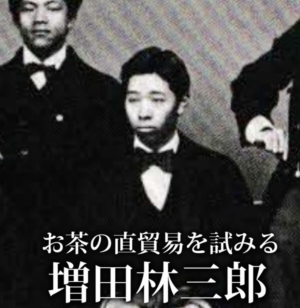
The man seated at the far right of the front row in the group photograph is Rinzaburo Masuda.
Masuda traveled to America with the ambition of establishing direct trade in Japanese tea—exporting it without relying on foreign intermediaries.
Momotaro Sato’s brother-in-law was involved in the tea trade, and Sato himself was actively exploring the potential of direct exports, maintaining close ties with tea producers in the Sayama region. It is likely through these connections that Masuda joined the Oceanic Group.
In Rioichiro Arai’s diary, there is a passage describing January 1877—their first New Year in America—when Arai, Morimura, and Masuda took a walk together through Central Park.
One can easily imagine the modest New Year’s celebration shared by three young men far from home.
However, strong domestic tea trade associations in Japan made it difficult to establish a unified export system, and the dream of direct tea trade failed to progress as hoped.
Possibly as a result, Rinzaburo Masuda is believed to have returned to Japan not long afterward.
Chushichi Date — Carrying the Mitsui Name Across the Sea
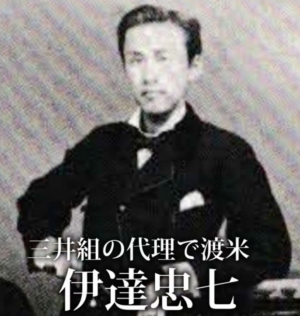
The man standing at the right in the back row of the photograph is Chushichi Date.
Date was connected to the Mitsui-gumi (the predecessor of Mitsui & Co.) and traveled to the United States with the goal of selling Japanese art and crafts.
The year 1876 coincided with the period when Mitsui was beginning to formalize its business structure in Japan. Date had already assisted in exhibiting Japanese products at the 1873 Vienna World Exposition, making him one of the few Japanese with firsthand overseas experience at the time. It is not difficult to imagine that Mitsui sent him abroad with high expectations.
Although surviving records on Date are limited, multiple sources confirm that he returned to Japan relatively early.
Even the highly trusted Mitsui organization struggled in its initial American trade ventures. One account suggests that Mitsui approached Rioichiro Arai about handling raw silk sales, but Arai was fully committed to the business of the Doshin Company, founded by his elder brothers, and the plan never materialized.
After 1895, Mitsui re-entered overseas trade in earnest and achieved major success in silk exports.
Whether Chushichi Date played any role in this later expansion remains unclear.
Toichiro Suzuki — The Most Tragic Ending
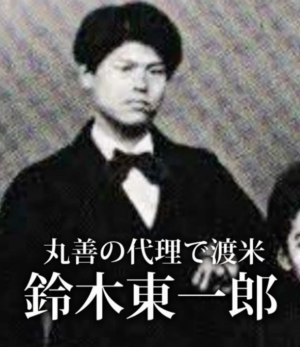
Finally, the man standing at the left in the back row of the photograph is Toichiro Suzuki.
Suzuki was dispatched to the United States as a sales representative for Maruzen, and he was also a graduate of Keio Gijuku.
Today, Maruzen is best known as a bookstore, but in the early Meiji period it began as a general trading company, importing foreign knowledge and goods into Japan.
Maruzen’s founder, Yuteki Hayashi, was a disciple of Yukichi Fukuzawa, who strongly advocated overseas trade. With Fukuzawa’s support, Hayashi established Maruzen, and Fukuzawa is said to have actively recommended talented individuals to him.
Given that Momotaro Sato consulted Fukuzawa about recruiting members for the Oceanic Group, it is quite possible that Suzuki’s name emerged during that process.
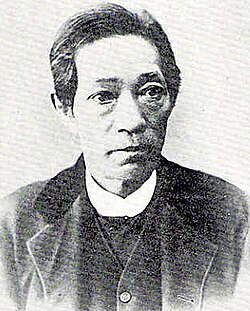
Suzuki arrived in the United States in 1876, but returned to Japan in April 1877 for reasons that remain unknown.
Just two months later, in June 1877, records indicate that he took his own life in the mountains of Kanagawa Prefecture.
Suzuki’s name appears only sparingly, if at all, in Maruzen’s official histories and photographic archives.
In fact, a person who traveled to America around 1910 is often described as Maruzen’s first employee to work in the United States, suggesting that Suzuki’s existence was largely erased from institutional memory.
In his diary, Ryoichiro Arai recorded that he and his companions mourned Suzuki’s death together.
Upon learning of the tragic fate of a fellow traveler who had shared the same aspirations, one cannot help but wonder what thoughts passed through their minds.
Those Who Succeeded, and Those Who Were Forgotten
Within the Oceanic Group centered on Momotaro Sato,
the only members who ultimately achieved lasting commercial success were Rioichiro Arai and Toyo Morimura.
The remaining four—including Sato himself—returned to Japan before fulfilling their ambitions, or met tragic ends.
The dawn of Japan–U.S. trade was not shaped by stories of success alone…